

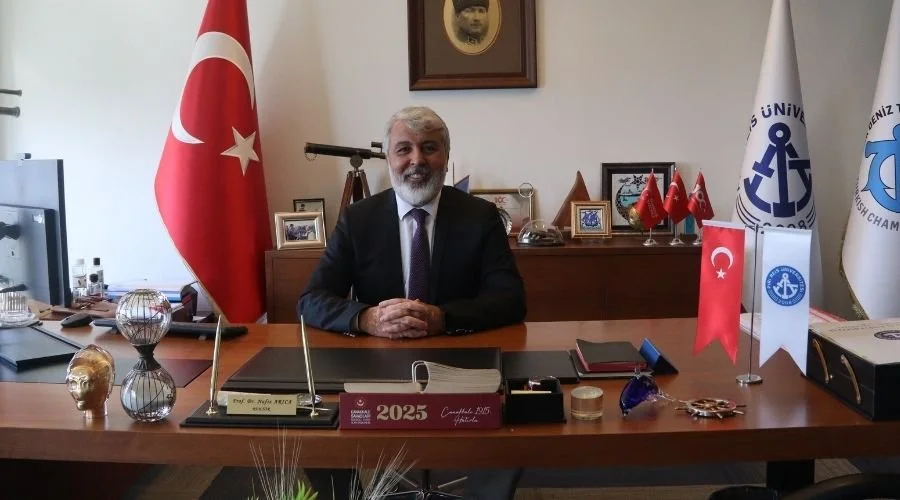
"As Piri Reis University, one of our priorities is to graduate our students as individuals who have mastered technology"
Yazar: Eda GEDİKOĞLU
22 Eki 2025
The maritime sector is undergoing one of the most profound periods of change in its history, shaped simultaneously by digitalization and green transformation. This transformation necessitates not only technological innovations but also the development of a qualified workforce. Piri Reis University stands out as one of the sector's centers of knowledge, technology, and human resources in this process of change. We spoke with Prof. Dr. Nafiz Arıca, Rector of Piri Reis University, about the university's strategic goals, its contributions to the sector, and its vision for the future, covering a broad spectrum from digital and green transformation in maritime education to artificial intelligence integration, the MENTORUS Project, and the Green Transformation Platform.
The maritime sector is undergoing one of the most profound periods of change in its history, shaped simultaneously by digitalization and green transformation. This transformation necessitates not only technological innovations but also the development of a qualified workforce. Piri Reis University stands out as one of the sector's centers of knowledge, technology, and human resources in this process of change. We spoke with Prof. Dr. Nafiz Arıca, Rector of Piri Reis University, about the university's strategic goals, its contributions to the sector, and its vision for the future, covering a broad spectrum from digital and green transformation in maritime education to artificial intelligence integration, the MENTORUS Project, and the Green Transformation Platform.
Piri Reis University stands out in artificial intelligence and digitalization-focused projects. How do you plan to integrate autonomous ships, digital twin technologies, and cybersecurity into your educational curriculum in the coming period? Do you organize training programs in this field for the sector?
I am one of those who believe that all the relevant technologies we have gathered under the heading of artificial intelligence technologies will significantly impact our education system. For this reason, I believe that integrating artificial intelligence into higher education, especially at our university, is of great importance.
As a scientist who has been working as a researcher in this field for about 30 years since my graduate studies, I want to take a leading role in the use of artificial intelligence technologies at my university. In this period when higher education has been intensely debated in recent years, we believe that artificial intelligence technologies will fundamentally transform higher education.
To this end, we have formed a team consisting of academics from different departments. Working together since around March, we have prepared the Piri Reis University Artificial Intelligence Policy Document, implementation principles, and action plan. This plan is structured around one-, three-, and five-year goals.
Our aim is to integrate new technologies, primarily artificial intelligence, into our education system and ensure that our students graduate with the highest level of competence and technological awareness.
''The Mentorus Project aims to make significant contributions to the development of human resources in the maritime sector''
Piri Reis University was awarded the “Certificate of Excellence” under the European Maritime University MENTORUS Project and was invited to speak at an information meeting organized by the National Agency. The MENTORUS Project aims to establish resilient and sustainable university structures in maritime education. Could you evaluate the role Piri Reis University has assumed within this project, its project management experience, and its contributions to the sector? How do the efforts made by Piri Reis University during this process provide a roadmap for the Turkish maritime sector and international educational collaborations?
The Mentorus Project is an Erasmus+ project carried out in collaboration with various universities across Europe. As Piri Reis University, we are also a partner in this project. The main objective of the project is to establish a joint maritime university with a focus on online education, thereby ensuring cooperation and mobility in maritime education on a European scale.
In this context, the goal is to make the most effective use of current educational technologies, to spread distance learning in the field of maritime studies, and to develop a high-quality education model by sharing the knowledge and experience of different universities.
Currently, approximately 1.8 million seafarers are employed worldwide, and the sector is growing at an average rate of 3% to 3.5% per year. In line with this growth trend, it is predicted that there will be a shortage of more than 90,000 seafarers by 2026. This shows that there is a continuing serious need for seafarer employment in Turkey, as well as on a global scale.
The Mentorus Project aims to make significant contributions to the development of maritime human resources by bringing together the shared experiences and educational resources of European universities. We, as Piri Reis University, are delighted to represent Turkey in this project and contribute to maritime education.
'As Piri Reis University, we are organizing meetings titled “Green Transformation Platform” and “Digital Transformation Platform” in collaboration with our Chamber of Shipping.'
The “Green Transformation Platform: Green Policies and Feasible Projects” sessions, launched in collaboration with the Turkish Chamber of Shipping, are seen as an important step in the maritime sector's journey towards environmental sustainability. How do you assess the contribution this platform will make to Turkey's green shipping vision and international competitiveness?
We are currently discussing two fundamental areas requiring transformation worldwide: digitalization (digital transformation) and green transformation. These two areas are often referred to as “twin transformations” because they are not easily separable from one another. At Piri Reis University, in collaboration with our IMEAK Chamber of Shipping, we began organizing phased meetings last year under the headings “Green Transformation Platform” and “Digital Transformation Platform.” These meetings are held monthly, alternating between the themes of digital transformation, green transformation, and business transformation, and will continue this year.
All stakeholders, including the government, universities, industry representatives, non-governmental organizations, and chambers, come together on these platforms. The goal is to create an interactive roundtable environment where everyone shares their views and experiences, unlike traditional formats where few speak and many listen. In this way, we aim to accelerate the digital and green transformation process of the maritime sector.
We are working to ensure that stakeholders join forces by sharing their experiences interactively, develop joint projects, and complete the transformation of the maritime sector in both areas in a healthy and rapid manner through these projects. We will continue this process with determination next year and in the years to come.
For example, we have prepared six project proposals on alternative fuels and related topics within the scope of sustainability. We have shared these projects with various stakeholders in the maritime sector, and as a university, we aim to implement these projects together with the relevant parties.
“With our simulators, laboratories, and workshops, we have one of the most advanced infrastructures in the world.”
The technical characteristics, operational risks, and regulatory requirements of alternative fuels add new dimensions to traditional maritime education. To prepare your students for this transformation, do you include courses or practical applications in your current curriculum on fuel technologies, fuel storage safety, and emission control systems? Also, are practical scenarios for the use of fuels such as LNG and hydrogen being developed in your simulation center or laboratory environment?
The issue of increasing technological awareness and competence that I mentioned earlier was extremely important in maritime education and will continue to be so. This field is developing more and more every day. In this regard, we took an important step last year and are now repeating this process continuously. We have updated the curricula of all our faculties, including not only our Faculty of Maritime Studies, but also our Faculty of Engineering, Faculty of Economics and Administrative Sciences, Faculty of Law, and Vocational School. We have created a stronger education model that meets the needs of the age by including topics related to new technologies in our course programs, both in terms of content and application.
As Piri Reis University, we are well aware of how critical applied education is in the maritime sector. Therefore, I can confidently say that we have one of the most advanced infrastructures in the world with our simulators, laboratories, and workshops. Our Simulator Center houses 13 different simulators, and all the equipment in our workshops and laboratories is designed to provide our students with the technological skills required by the maritime sector. Moreover, we continuously update this infrastructure with new systems as technology advances.
Therefore, one of our top priorities is to graduate our students as individuals who are proficient in technology. Artificial intelligence, alternative fuels, green technologies, digitalization... We aim for our students to be well-equipped with both theoretical and practical knowledge in all these areas. In education, application is as important as knowledge.
“Our university is Turkey's first and only ‘maritime economics university’ and is directly affiliated with the maritime sector.”
At this point, I would also like to mention practical applications in the field. Universities establishing strong ties with the industry not only improves the quality of education but also increases employment opportunities for graduates. Piri Reis University sets an exemplary model in this regard through its internship and collaboration programs with shipyards, shipowners, and logistics companies.
Our university is Turkey's first and only “maritime economics university,” making it the university directly serving the maritime sector. This is our greatest strength. A wide range of industries, from shipowners to shipyards, port operators to logistics companies, stand behind Piri Reis University. Because Piri Reis University was founded by the maritime sector itself. Therefore, we are within the sector, and the sector is within us. Within this framework of cooperation, both our academic units and our student clubs organize numerous events every year. Last year alone, approximately 350 events were held by our student clubs, and the vast majority of these were carried out together with representatives of the sector.
Thanks to this strong industry collaboration, our students have no trouble accessing the industry, finding internships, or securing employment. All they need is the desire to work in the maritime industry.
Because, to our knowledge, there is no other “sector university” in Turkey besides Piri Reis University. There are chamber universities, but there is no other university established directly by a sector and focused on that sector. In this respect, Piri Reis University holds a unique position. We actively leverage this strong structure for the future of our students. According to our latest graduate survey, our employment rate stands at 93%. The remaining 7% are not actively involved in the maritime sector for various personal reasons.
“Piri Reis University students graduate with maritime licenses valid worldwide.”
As the maritime sector rapidly transforms, universities establishing strong ties with the industry not only enhance the quality of education but also increase the employment success of graduates.Could you provide information about the internships, practical training, and R&D projects that Piri Reis University carries out with shipyards, shipowners, and logistics companies? How do these collaborations contribute to your students' professional development?
We are already a member of the International Association of Universities. Like other state universities in Turkey, the education we provide is approved by our Ministry of Transport and Infrastructure. Therefore, our education programs are recognized and certified by international organizations such as the IMO (International Maritime Organization) and EMSA (European Maritime Safety Agency). Within this scope, Piri Reis University students graduate with maritime licenses valid worldwide and have the opportunity to find employment on a global scale. For this reason, we do not experience any problems regarding the employment of our graduates.
Furthermore, through our partnerships and agreements with international universities and maritime companies, we aim to further develop our internationalization vision. These partnerships offer our students not only theoretical education but also the opportunity to play an active role in practical training and R&D projects. Thus, our students gain sectoral experience and become part of the global maritime network.
Is there anything else you'd like to add?
I would like to present the topic to you from a broader perspective, moving from the general to the specific. It is predicted that technological developments over the next 10 years will be equivalent to those experienced over the past 250-300 years. We are currently experiencing the fastest technological changes in human history. On the other hand, the education sector in general is one of the most resistant to change, one of the most conservative areas. On the one hand, we are in the fastest transformation process in human history, while on the other hand, there is conservatism in education, where traditional structures prevail. Therefore, we are facing a dilemma; however, we must bring about this change. As managers of educational institutions, it is our responsibility to set out this vision and steer our institutions in this direction.
As I mentioned earlier, artificial intelligence is one of the most important elements of this transformation. Our goal is to ensure that our students graduate as individuals with high technological awareness and competence. We are working intensively towards this goal.
Piri Reis University, as a Maritime Specialized University, is structured to serve the maritime sector entirely, not only through its Faculty of Maritime Studies but also through its Faculty of Engineering, Faculty of Law, Faculty of Economics and Administrative Sciences, Faculty of Science and Letters, Maritime Vocational School, and Graduate School.
Of course, our Engineering, Law, and Economics and Administrative Sciences Faculties have different departments. However, the education provided in departments such as Computer Science, Electronics, Industry, Law, Economics, and Finance is also designed to contribute to the maritime sector. In our Law Faculty, we specialize our students in maritime law. Our computer engineering students receive training that will serve the digital transformation in maritime affairs, while our economics and finance students are equipped with additional courses on maritime economics. In other words, Piri Reis University, Turkey's first and only Maritime Specialized University, aims to train qualified human resources that will serve the maritime sector directly or indirectly.
With our plans, programs, and investments, we aim to enter the world's top 1000 universities in the coming years and then climb even higher in the rankings. Our university has a boutique structure; it is a sector-specific university and deserves to reach much better positions. We are working hard towards this goal.
Piri Reis University, Prof. Dr. Nafiz Arıca
Bültene Kaydol
Gelişmelerden haberdar ol
İlgili İçerikler
“Uluslararası Standartlara Uygun, Güvenli ve Sürdürülebilir Taşımacılık Anlayışıyla Faaliyet Gösteriyoruz”
5. Türkiye Denizcilik Zirvesi kapsamında, ACECHEM TANKER Uzak Yol İkinci Gemi Kaptanı Ozan Gerçek ile bir araya geldik. Türk denizciliğinin son yıllardaki gelişimini, Kabotaj Kanunu'nun 100. yılının sektöre kazandırdığı farkındalığı ve denizcilik organizasyonlarının sektörün geleceğine sağladığı katkıları değerlendiren Gerçek, Türk denizciliğinin uluslararası alandaki konumunun her geçen gün güçlendiğini vurguladı.
Yazar: Eda GEDİKOĞLU
14 Ağu 2026
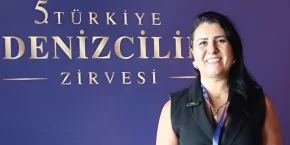
“Türk Denizciliğinin Geleceği İçin Güçlü Milli Filo ve Güçlü Kadın Denizciler”
5. Türkiye Denizcilik Zirvesi kapsamında Türk denizciliğinin öncü isimlerinden biri olan Türkiye Denizcilik İşletmeleri Deniz Yolları İşletmesi İlk ve Tek Kadın Kaptanı ve Kadın Gemi Kaptanları, Mühendisleri ve Denizciler Derneği Kurucu Başkanı Sedef Esra Ulutürk Dinç ile bir araya geldik. Türk bayraklı yolcu gemilerinde görev yapan ilk Türk kadın kaptan olan Dinç, Kabotaj Kanunu'nun 100. yılının taşıdığı stratejik önemi, kadın denizcilerin sektördeki yükselen rolünü ve Türkiye denizciliğinin geleceğine ilişkin değerlendirmelerini anlattı.
Yazar: Eda GEDİKOĞLU
14 Ağu 2026

“Denizciliğin Geleceği Güçlü İnsan Kaynağıyla Şekillenecek”
Türkiye Denizcilik Zirvesi kapsamında QSM Global Kurucusu ve Karadeniz Teknik Üniversitesi Mezunlar Derneği Yönetim Kurulu Başkanı Orhan Kasap ile bir araya geldik. Zirvenin sektöre sağladığı katkıları, Kabotaj Kanunu'nun 100. yılının taşıdığı stratejik önemi ve Türk denizciliğinin geleceğine ilişkin değerlendirmelerini paylaşan Kasap, özellikle gemi insanı yetiştirilmesi ve nitelikli insan kaynağının güçlendirilmesinin sektörün sürdürülebilir büyümesinde kritik rol oynadığını vurguladı.
Yazar: Eda GEDİKOĞLU
14 Ağu 2026